
The Transparency Gap: Why the Owner-Operator Model is Broken
I recently saw Joe Pettigrew's post on LinkedIn that perfectly captures the shift we are seeing in the industry:
"I’m convinced the next era of hotel performance will be defined by owner-led, AI-enabled commercial operating models where profit is valued over profitability, execution takes a higher priority over strategy, and outcomes are celebrated over outputs."
I agree with his vision of the future, but it is currently being blocked by a structural "wall": The Traditional Owner-Operator Contract. Here are a few thoughts on how to make the relationship more transparent.
The Problem: Misaligned Incentives & "Strategic Blindness"
The relationship between hotel owners and operators has historically been built on a foundation of information asymmetry. This is driven by:
-
The Incentive Gap: Most management contracts reward operators based on Gross Revenue (Top-line). This encourages operators to chase volume and occupancy at any cost—even if the high cost of guest acquisition destroys the Net Profit (Bottom-line) the owner actually cares about.
-
The "Non-Interference" Clause: Many legacy contracts restrict owners from "interfering" in daily operations. In a world of manual reports and siloed spreadsheets, this effectively blinds the owner, forcing them to wait weeks for a curated, static "Owner’s Deck" that shows what happened in the past, rather than what is happening now.
The Solution: Real-Time Data as a Contractual Right
To thrive in an AI-enabled era, owners must move past "Strategic Blindness." Transparency doesn't mean micromanagement; it means alignment.
This is where Demand Calendar changes the game. It acts as a neutral, real-time commercial engine where both the owner and the operator view the same data.
1. From Slow to Instant: Real-Time Visibility
Demand Calendar speeds up the information flow from slow to instant. Owners no longer have to wait for the end-of-month meeting to see how the property is performing.
2. Strategy is a Milestone; Execution is the Daily Goal
Once a hotel has decided on its commercial strategy, 100% of the focus should shift to execution. Demand Calendar provides the Business Intelligence to track the execution daily.
3. Ending the Spreadsheet Era & Data Silos
By integrating data from PMS, RMS, and even time-keeping systems into one platform, Demand Calendar eliminates the "Silo Defense."
Checklist: 5 Questions for Your Operator (and the Demand Calendar Reality)
Use these questions in your next ownership meeting to see if your current operating model is built for the future.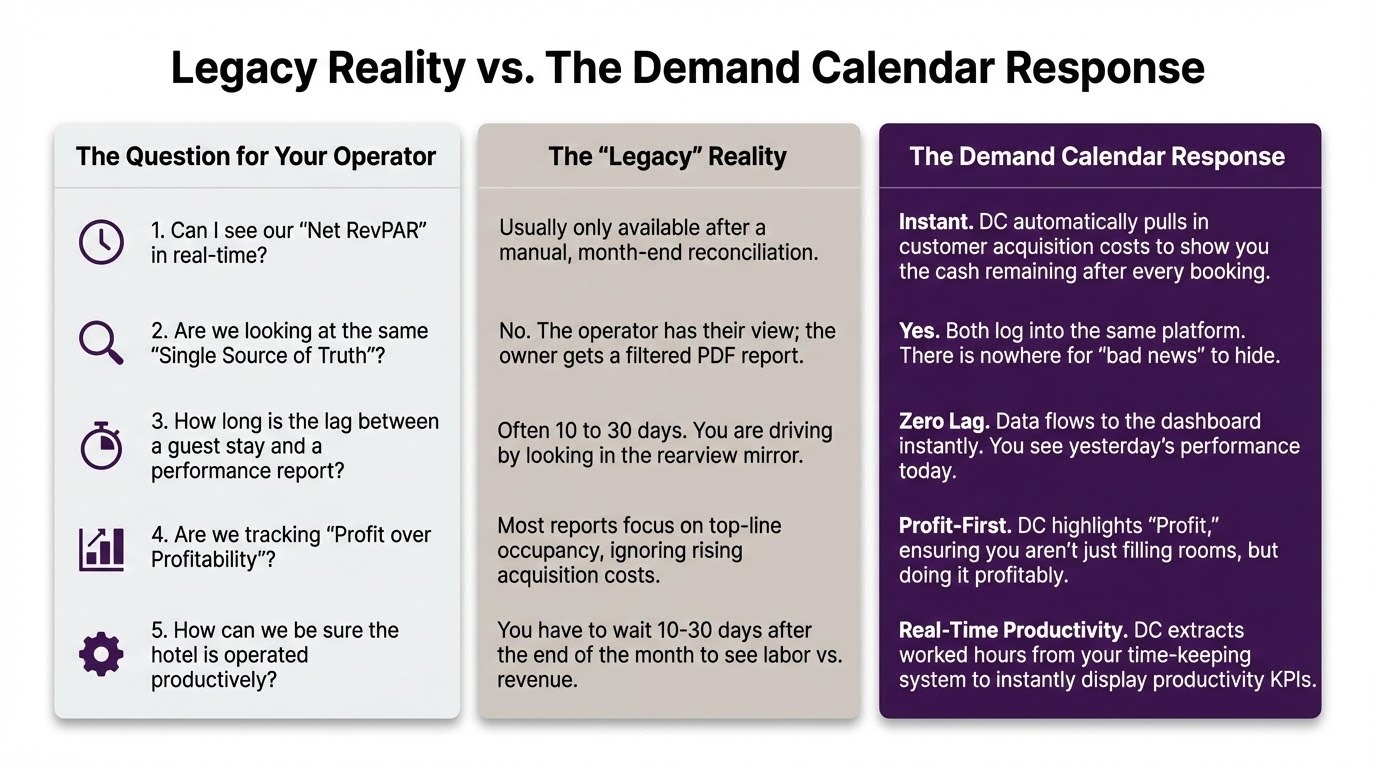
The Bottom Line
In the next era of hospitality, the "Non-Interference" clause cannot be used as a "Non-Information" clause.
Owners who use Demand Calendar aren't just buying a software tool; they are implementing a new commercial operating model. They are moving from a world of filtered reports to one of total transparency and high-speed execution.
Don't wait for the monthly meeting to find out your strategy isn't working. Demand the data now.
