
Stop Budgeting Rooms. Your Pattern Won't Change. Your Guests Can.
Most destinations repeat their year with remarkable discipline, which makes the room line of a budget the easy part and the wrong place to look for growth. Here is why the common segment-by-month method copies last year with more rows, how to build the budget in three layers instead, and what the per-guest layer is worth on a 100-room hotel.
Hotel Budgeting Starts With a Stable Year
Take any city and lay three years of monthly room nights, average rate, and RevPAR over each other. The lines almost overlap. Every large gap traces back to a handful of weeks, and every one of those weeks has a name: a medical congress, a trade fair, a concert series. In one of the cities, the biggest spike of the year moved from late March to early April. Nothing else in the year changed shape.
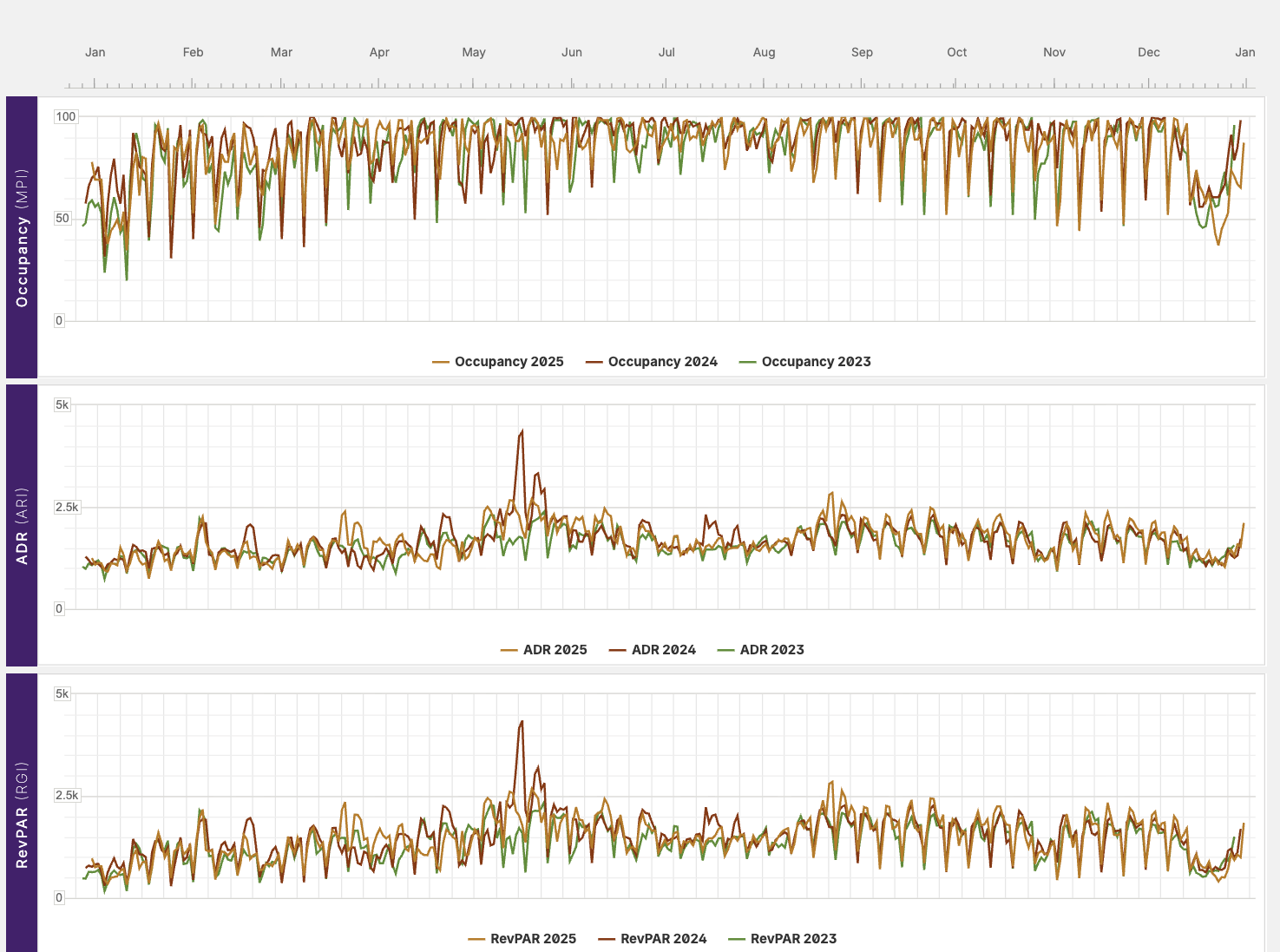
Destinations differ, and each has its own curve. What they share is that the curve holds from one year to the next. Business travel follows the working week and the trade fair calendar. Leisure follows school holidays and the weather. Your hotel's share of that demand moves slowly, and the market's total moves even slower.
For budgeting, the conclusion is uncomfortable. Room nights and rate are largely given by the destination. You can defend your share of them, and a strong revenue manager does. You rarely grow them by a meaningful percentage in one year, no matter what the budget template asks for.
Monthly Segment Budgets Copy Last Year
The method most hotels use looks rigorous. The budget is built by segment and month: 300 room nights of corporate business in March, 450 of leisure, 120 of groups. The monthly totals are then spread across the days according to last year's pattern.
Look at where the monthly totals come from. In most hotels, "300 corporate room nights in March" means last March times a growth factor, usually the same factor the owner asked for. The segment split adds detail. It adds no evidence. The result is last year plus a percentage, written in more rows.
The spreading step looks careful, because it follows the day of the week: each Saturday inherits a Saturday. The months themselves still change shape. July 2027 has five Saturdays, while July 2026 had four; August 2027 has four, while August 2026 had five, so the monthly totals carry the wrong number of weekend nights before a single day is spread. Last year's congress lands in last year's week, whether or not it returns. And an event that crosses a month boundary, like the March spike that moved into April, takes the wrong month's budget with it. The monthly totals look correct while both months are wrong.
The deeper problem is what the method leaves out. It budgets rooms and rate, the two numbers your history shows barely move, and it has no line at all for what each guest spends. The one lever with real room to grow never appears in the plan, so nobody owns it, nobody tracks it, and it never grows.
The segment is the right unit. The room night is the wrong thing to put in it.
Copy the Baseline by Weekday, Not Date
A stable destination is good news for the budget. Most of the year forecasts itself, provided you copy it correctly.
Start with last year's actuals, and remove every day that a one-off event shaped. What remains is the baseline: the ordinary Tuesday in February, the ordinary Saturday in June. Copy it into 2027 by weekday and week of the year, not by date, so the third Tuesday of February 2027 inherits the third Tuesday of February 2026.
The baseline covers most of the year, and it deserves a narrow range. If your three years agree within a few percent, the budget can say so. Spending weeks debating whether an ordinary November Wednesday will run one point higher is effort taken from the days that matter.
Research the Event Days One by One
The event layer is the small set of dates that decide whether the year beats budget or misses it. A city with a stable year might have fifteen or twenty such days, spread across four or five events.
Treat each one separately. Confirm the 2027 dates with the organizer or the convention bureau. Check whether the event rotates between cities and is due to leave. Note new events announced for 2027, and events that grow or shrink. Then budget each event day separately, with a wide range, because a congress either comes or it does not.
The work takes days, not weeks, because the list is short. It also gives the commercial team an early calendar of the dates where the hotel's pricing and group decisions carry the most money, long before the first booking arrives.
Growth Sits in the Per-Guest Layer
With the baseline copied and the events researched, the room line is largely set. The growth in the 2027 budget has to come from what each guest buys after they decide to stay with you.
That layer is missing from most budgets, so it needs its own lines. Build them by segment, because each segment spends, stays, and upgrades differently:
- Upgrade take-up: the share of each segment that moves to a better room type, and what they pay for it.
- Length of stay: the extra nights a segment adds, landing mostly on the quiet nights your stable pattern leaves empty.
- Spend per stay: food and beverage, parking, spa, early check-in and late checkout, per segment and per stay.
Each line gets a 2027 assumption, a named owner, and a monthly check. The leisure guest who books a weekend might add a Sunday night. The project team that stays four nights a week might take a parking package. The meetings delegate might stay for dinner if someone offers the table. None of these needs a single extra guest from the market.
Length of stay is the one room-night lever the stable pattern allows. A destination full on Saturday and half empty on Sunday has room for the extra night exactly where your hotel needs it.
What €10 per Room Night Is Worth
Put a number on the per-guest layer. A 100-room hotel at 65 percent occupancy sells 23,725 room nights a year. Add €10 of revenue per occupied room night, from upgrades and extra spend combined, and the year gains €237,250 in revenue.
Extra spend from a guest already in the house carries almost no acquisition cost, so around 80 percent of it reaches profit: roughly €190,000.
Now try to earn the same profit from rooms. At an average rate of €150, an extra room night contributes about €97.50 after acquisition cost and the variable cost of the stay. The hotel needs around 1,950 more room nights to match the €10, which is more than five occupancy points. Your chart has just told you those points are not coming.
How the €10 builds up week by week is set out in RevPOR Moves in Weeks. RevPAR Takes a Quarter. The budget point is simpler. A €10 gain that nobody budgeted has no owner, and a gain without an owner tends not to happen.
Give Each Layer Its Own Range
Three layers give the budget three kinds of uncertainty, and the owner deserves to see them separately.
The baseline carries a narrow range, because history supports it. The event layer carries a wide range, and the range names its drivers: the congress returns or rotates away. The per-guest layer carries a target with a monthly check, because it depends on what the hotel does, not on what the market does.
A single budget number blends the three and hides which one moved when the year goes off track. Three layers show it within the first month. If the baseline holds and per-guest revenue lags, the issue sits inside the hotel, and the fix starts on Monday. The hotel forecasting guide describes the weekly cycle that keeps all three layers current once the year begins.
Rebuild One Month This Week
Take one 2027 month that holds an event, and build it twice. First, the way your template asks: last year's segment totals plus the growth factor, spread by last year's days. Second, in layers: the baseline copied by weekday, each event day researched and ranged, and the three per-guest lines added by segment.
Put the two versions side by side at the next budget meeting. The difference shows how much of the first version is last year's calendar, and how much of the second version's growth comes from guests the hotel already has.
Demand Calendar is a total-revenue forecasting and profit system for hotels. It sits alongside your RMS and PMS, not instead of them.
Your destination already wrote most of next year's room line. The budget that grows is the one that plans what each guest buys, because a budget that only plans rooms plans a year you already know.
BOOK A STRATEGY CALL → demandcalendar.com/book-a-call
